
Nail Gun Safety Regulations in the UK: Are You Compliant?
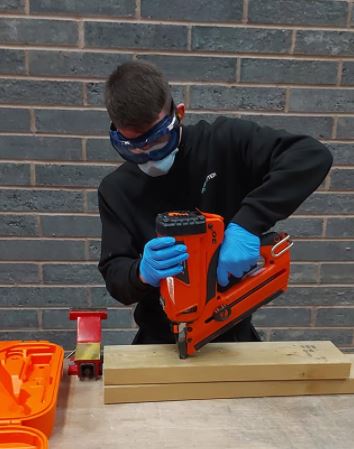
If your business uses nail guns – whether battery-powered, pneumatic, or gas-fired – it’s vital to ensure you’re operating in line with UK regulations. As a provider of specialist training, Apple Group understand the risks and requirements. Here’s how to check that you’re compliant to protect your workforce and reduce liability.

Why Nail Gun Safety Matters

Nail guns are powerful tools that greatly improve productivity in construction, carpentry, roofing, flooring and other trades.However, nail guns pose significant risks. According to the Health and Safety Executive (HSE), this includes the risk of a nail being deflected or splinters being ejected towards the operator or others. Similarly, misuse of a nail gun or poor maintenance can lead to serious injury, including puncture wounds, broken bones, eye injury, and in extreme cases, permanent damage.And it’s not just about the tool. Incorrect environment, lack of training, improper PPE and inadequate supervision all contribute to workplace safety when using a nail gun. Hence, you must treat nail gun use as a significant hazard, and implement controls accordingly.

Key UK Regulations You Must Follow

Here are the principal legal frameworks governing nail gun use:

Health and Safety at Work etc. Act 1974 (HSWA)

This is the overarching duty for employers – to ensure, so far as is reasonably practicable, the health, safety, and welfare of employees.

Provision and Use of Work Equipment Regulations 1998 (PUWER)

These regulations require that work equipment (including power tools such as nail guns) is appropriate for use, maintained, inspected, used only by trained/competent persons, and accompanied by suitable instructions.

Personal Protective Equipment at Work Regulations 2022

Employers must provide suitable PPE (and train people in its use) when risks cannot be adequately controlled by other means.

Control of Noise at Work Regulations 2005 & Control of Vibration at Work Regulations 2005

Although not specific to nail guns, these must be considered where users are exposed to high noise or vibration from power tools.In sum, you need to conduct risk assessments for nail-gun work, ensure the equipment is safe and maintained, ensure the user is trained and competent, provide PPE, and monitor health risks where relevant. 

What You Should Check for Compliance

Here’s a practical checklist you can walk through to check that you’re compliant:

Risk Assessment

Have you undertaken risk assessments that include nail-gun use, covering tool malfunction, ricochet, recoil, noise, vibration, and falling objects?Have you documented the hazards and defined control measures?Are the assessments regularly reviewed (especially when changes occur – different tool, task, environment)?

Equipment & Maintenance

Is every nail gun suitable for its task (type of work, materials, environment)?Are you following the manufacturer’s instructions for use, maintenance and inspection?Are you carrying out pre-use checks – e.g. safety tip, trigger, air/gas supply, jam clearing, magazine condition?Are all nail guns inspected and maintained, with up-to-date records for each tool?Do you remove defective equipment immediately?

Training & Competence

Are all operatives using nail guns trained in safe use, hazards, the correct tool for the task and emergency procedures?Are supervisors aware of the correct firing modes (sequential vs contact) and when to use them?Has the training been documented and recorded, with documented training for every operator and supervisor?Do you provide refresher training and ensure supervisors check competence regularly?

Safe Working Practices

Is the work area organised? Are bystanders kept clear, and is the line of fire controlled? Are users controlling their posture, tool angle, and avoiding awkward positions where possible?Is the tool never pointed at any person, even if it appears empty?Is the trigger not held down when moving or climbing?Is the gun isolated/disconnected when clearing jams, passing the tool or leaving it unattended?Are tool-specific hazards (ricochet, recoil, misfire, ladder work) identified and controlled?

PPE and Health Monitoring

Is eye protection (safety glasses/goggles) worn by operatives?Is hearing protection provided and used when required based on a noise risk assessment?Are appropriate gloves, protective boots and other PPE provided according to the risk?Is health surveillance considered where relevant (noise, vibration, upper limb disorders)?Is PPE provided, used and checked? Are noise/vibration risks assessed?

Supervision & Records

Are users supervised appropriately according to their experience, ability and the complexity of the tool/task? Are incidents or near-misses involving nail guns recorded and investigated to identify root causes and prevent recurrence? Are your inspection, training and maintenance records maintained and easily accessible for audit/inspection?Do you have a written nail gun safety policy or procedure? 

How Apple Group Can Help

At Apple Group, we provide specialist training and consultancy to help you stay compliant and keep your workforce safe.Our Nail Gun Practical Use & Awareness course covers battery, pneumatic and gas-powered nail guns, and includes legal requirements (PUWER, MHSWR) and practical supervised use.We can support you with bespoke risk assessments, method statements (RAMS), auditing of equipment and toolbox talks tailored to nail gun hazards.We help you embed safe working practices, maintain records and ensure you’re inspection-ready.

Nail Gun Safety – Are You Compliant?

Nail guns bring efficiency, but they also bring real risk. If you’re using them on site in the UK, you must ensure you’re compliant for your legal duty and for the safety of your workforce. Performing the checks above can reveal whether you’re operating safely or leaving gaps.Ready to book your nail gun course? Contact us today and let’s ensure you’re fully compliant and confident. Or if you’d like to discuss how to audit your current practice, deliver training, or update your nail gun safety procedures, get in touch today, and we’ll help you raise safety standards.